Core Technology
AL-NH₃ Heat Pipes
Aluminum-ammonia heat pipes with 15,000 W/mK effective thermal conductivity — 37× solid copper. Three construction variants from proven groove wicks to fully 3D-printed geometries.
Technology
Proprietary 3D-Printed Wick
EW JET's sintered wick geometry is designed computationally — capillary radius and permeability are controlled parameters, not a consequence of tooling. Enables wick performance not achievable with machined grooves or standard sintered powder.
Aluminum-Ammonia Working Pair
NH₃ has high latent heat of vaporization and a wide liquid operating range. Chemically compatible with aluminum — no copper liner required. Well characterised across the full space thermal environment.
Space-Grade Design Process
Designed with reference to ESA/ECSS space engineering standards. Vibration, thermal-vacuum, and leak testing available per qualification plan. Contact us for testing protocol documentation.
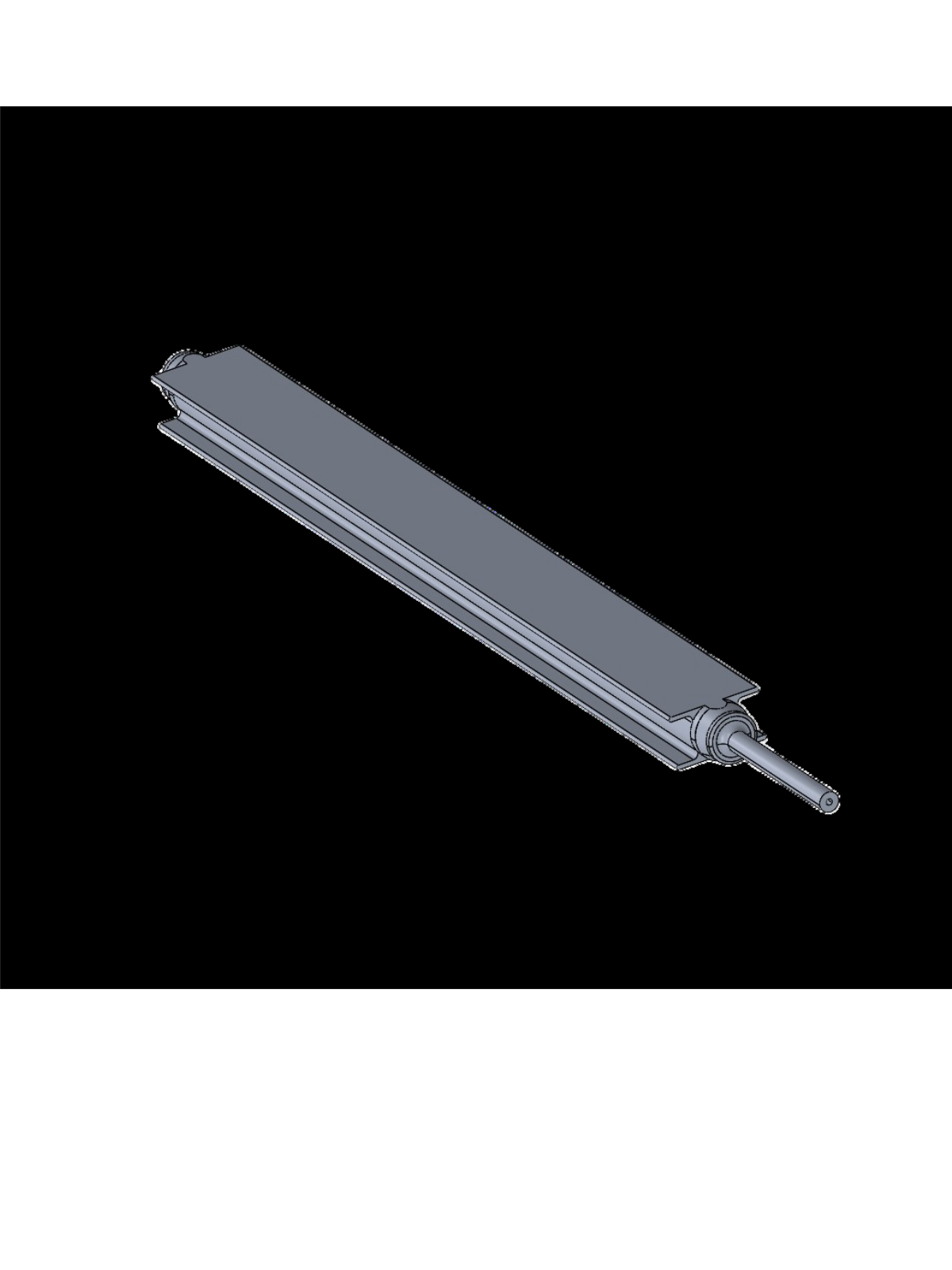
Aluminum Extrusion Body
6000-series alloy extrusion body. Precise internal channel dimensions, low mass, compatible with standard spacecraft mounting interfaces. Leak-tested 100% of units — fully enclosed system.
Applications
GEO Satellites
Long-duration comms and broadcast payloads. 15+ year mission life with no active components or maintenance access.
LEO / SAR Satellites
Rapid thermal cycling under −100°C to +100°C orbit environment. High-flux SAR payloads where groove wicks reach their capillary limit.
CubeSat & SmallSat
Compact custom assemblies for 1U–3U platforms and 50–200 kg smallsats. 3D-printed body enables tight-fit structural integration.
Construction Variants
Three product types — different wick structures for different requirements. Choose based on heat load, tilt tolerance, and geometry constraints.
Extruded aluminum body with machined axial grooves as the wick. The groove geometry is fixed by the extrusion die — no custom pore structure. Standard form factor used in spacecraft thermal control for decades.
Advantages
- Shortest lead time — die-extrusion production
- Lowest unit cost at volume
- Extensive space flight heritage
- Straightforward qualification path
Limitations
- Lower Q_max than sintered/3D-printed wicks of same OD
- Performance degrades significantly at adverse tilt
- Not suitable for high-flux or vertical mounting
Choose this when
Your heat load is within the groove wick Q_max envelope, pipe is roughly horizontal, and cost or delivery schedule drives the decision.
Standard extruded aluminum body with EW JET's proprietary 3D-printed sintered wick insert. The wick pore geometry is computationally optimised — much finer capillary structure than machined grooves, in the same pipe envelope.
Advantages
- Higher Q_max vs groove wick at same OD
- Handles adverse tilt — capillary pressure overcomes gravity head
- Custom wick geometry per application
- Proven extrusion body — existing spacecraft interfaces fit
Limitations
- Higher cost than groove variant
- Longer lead time — printed wick insert
Choose this when
Q_max requirement exceeds what groove wicks can deliver, or the heat pipe must operate at adverse tilt (evaporator above condenser).
Entirely additive-manufactured aluminum — body and wick printed as a single integrated piece. The key capability is geometry freedom: non-circular cross-sections, L-bends, curved paths, and integrated mounting features that extrusion cannot produce.
Advantages
- Arbitrary geometry — curved, branched, non-circular
- Integrated mounting bosses and interface features
- Novel wick topologies — gradient porosity, lattice structures
- No straight-pipe constraint on structural layout
Limitations
- R&D stage — performance not fully characterised
- As-printed Al has lower thermal conductivity than wrought alloy
- Longest lead time — custom per geometry
- Higher cost
Choose this when
Spacecraft structure doesn't accommodate a straight round pipe — curved routing, flat panels, or tightly integrated thermal-structural design is required.
Side-by-Side Comparison
| Groove Wick | 3D Wick Insert | Full 3D Printed | |
|---|---|---|---|
| Body construction | Extrusion | Extrusion | Additive (SLM) |
| Wick type | Axial groove | 3D-printed insert | 3D-printed integral |
| Q_max (300 mm) | TBD W | TBD W | TBD W (R&D) |
| Rth (300 mm) | TBD K/W | TBD K/W | TBD K/W (R&D) |
| Adverse tilt | TBD° | TBD° | TBD (R&D) |
| Custom geometry | OD / length only | Wick pore geometry | Full 3D freedom |
| Lead time | Short | Medium | Custom / R&D |
| Production status | Ready | Ready | On request |
Q_max and Rth values pending test data. All TBD values measured at 300 mm test length — see Performance Data below.
Specifications
Values marked TBD are variant- and configuration-dependent. Contact us for a scoped datasheet.
Full datasheet on request. All performance values vary between Groove Wick, 3D Wick Insert, and Full 3D Printed variants.
Performance Data
Test basis: 300 mm length, same outer diameter, NH₃ working fluid, horizontal orientation. Fixing length and OD isolates wick structure as the only variable.Note: Performance varies with pipe length — longer pipes have higher transport resistance and lower Q_max. Datasheet for your specific length available on request.
Performance varies with pipe length, OD, and operating temperature. Longer pipes have lower Q_max due to increased transport resistance.
Request datasheetWhy Aluminum-Ammonia
Common alternatives each have a critical limitation that AL-NH₃ avoids.
- Compatible with aluminum spacecraft structures — no galvanic corrosion risk
- NH₃ works across cryogenic-to-high-temp range that water cannot cover
- ~3× lower mass per metre vs copper body at equivalent transport capacity
- 3D routing — not constrained to flat, thin sheets
- Higher total heat transport (W), not just high in-plane conductivity
- Robust to launch vibration and structural loads
- Simpler construction — no compensation chamber, reservoir, or grooved saddle
- Lower unit cost for standard transport lengths
- No startup or priming sensitivity
Custom Configuration
Tell us your heat load, available pipe envelope, operating temperature, and orbit or mounting orientation. We scope the right variant, OD, and length.
Complete the Thermal System
Questions about custom geometries or qualification? Talk to our engineering team.